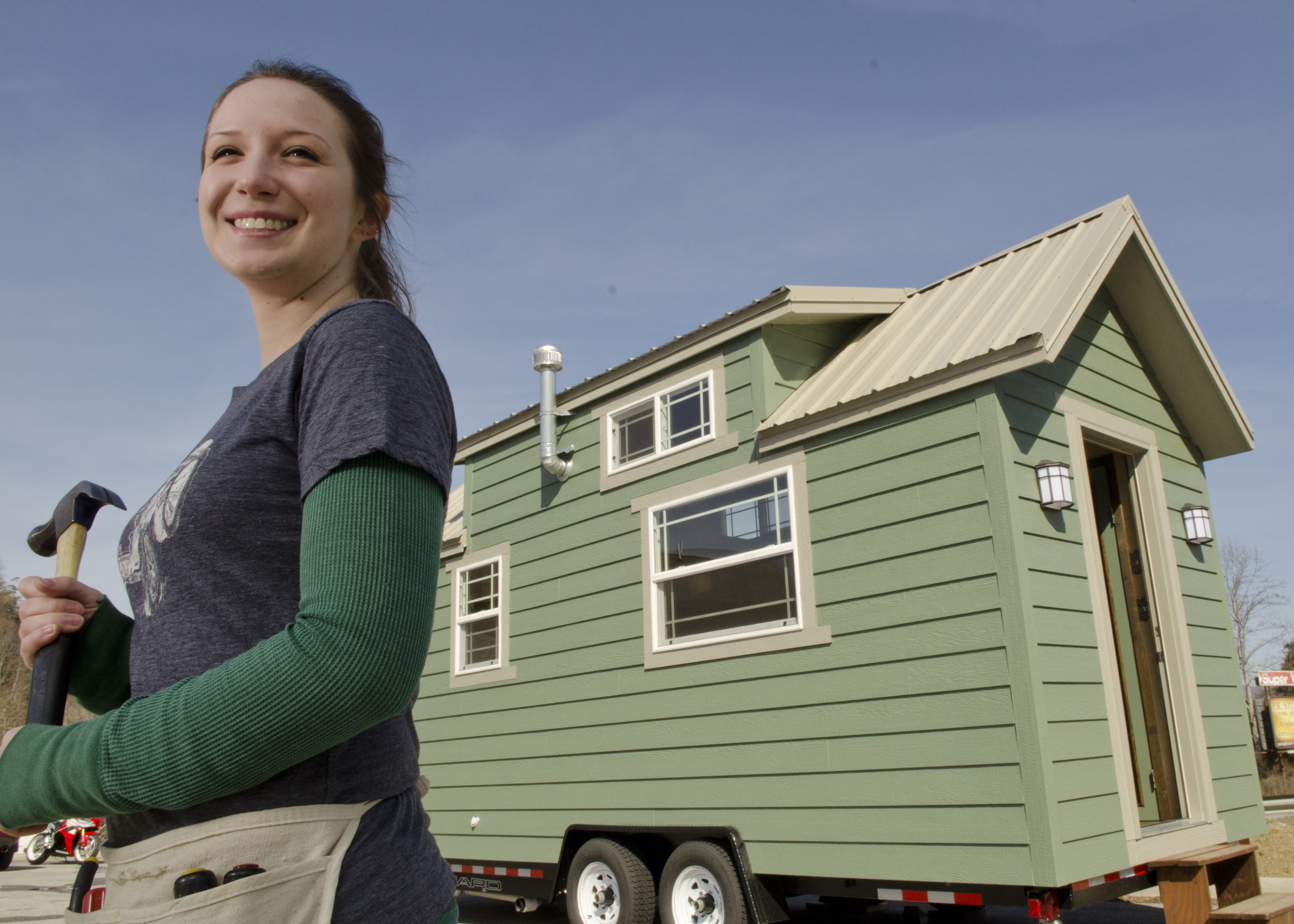
Thanks for stopping by! My name is Sarah and I built a very small, mobile house as a final project to complete my Master of Science in Environmental Policy and Management. I grew up in Manassas, VA but went to high school and college in southwest VA. I built the house near Blacksburg, VA on my parents’ land.
To fund the project, I borrowed money from the local Bank of Dad and needed to sell the house to repay that loan. Since this is an educational venture, this page details the specifics and rationale behind the wee house project. In addition to actually building the structure, I will continue to update this blog as time permits.
_
 ____________________________________________________________________________________
Introduction
Environmental sustainability is successful if it balances 3 main categories: environment, economy, and society. Tiny houses can be built using many reclaimed and recycled materials and can be wired to be “off the grid” (environment). Although sold professionally from builders at prices of around $30,000 to beyond $50,000, they can be built DIY style for significantly less. Another benefit of these houses is that they require no mortgage and can reduce a person’s debt significantly (economy). As we lessen our impact on the environment and people dig out from debt, we can live more fulfilling, healthy, and free lives. These homes can also provide relatively cheap shelter for those in need or act as secondary housing for vacations or emergencies (society). This blog will regularly rate my activities based on these 3 categories (for example, buying a used ceiling fan rates high on economy but low for the environment if it’s an electricity guzzler).
Rationale
The tiny house movement has increased in popularity and awareness over the last decade. This project capitalizes on the amount of information on tiny house living and building in order to act as a final project for my degree. The focus on the environment, economics, and society relate directly to my degree’s concentration in Environmental Sustainability because it focuses on the 3 tenants of this field.
Project Description
The house will be built on a trailer with the goal to use as much recycled or reclaimed material as reasonably possible. Construction will strike a balance between the environment (eco-materials), economics (compromising eco versus regular materials), and society (using strong materials and building correctly for safety). It requires some construction knowledge but I will rely on purchased plans, detailed DIY book, and other tiny home builders’ blogs and guidance. This project aims to prove that an “average” person can accomplish it on a small budget. It is acknowledged that the “average” person may not have a construction expert on-hand, but my sponsor’s periodic inspections will be vital to ensuring the safety of the project. Throughout the duration of this venture, I will keep a blog for other tiny house enthusiasts to learn from my successes and mistakes and complete a research paper for the course.
Inspiration
I took all my Core and Concentration courses and still had little idea for what I would do for my final thesis/research paper. I’m not the kind of person who can write 50 some pages on an obscure scientific topic! I had one course to take to fulfill the Elective requirements of my degree, so I signed up for Advanced Green Logistics, which is under the Reverse Logistics realm. Boy was that an eye-opener. Prior to this, I was already obsessed with tiny houses. At some point, I started to put green logistics/recycling/reclaimed materials and building a tiny house together as an abstract thought. Eventually, I figured out a way to make both constructing this house and writing about small living options the final project to complete my degree. This is a topic I am passionate about and physically building the house gives me something hand-ons to show for my otherwise entirely online degree. I am very thankful to my parents for their support.
 Rocky Sink Farm